
Eternal Smiles
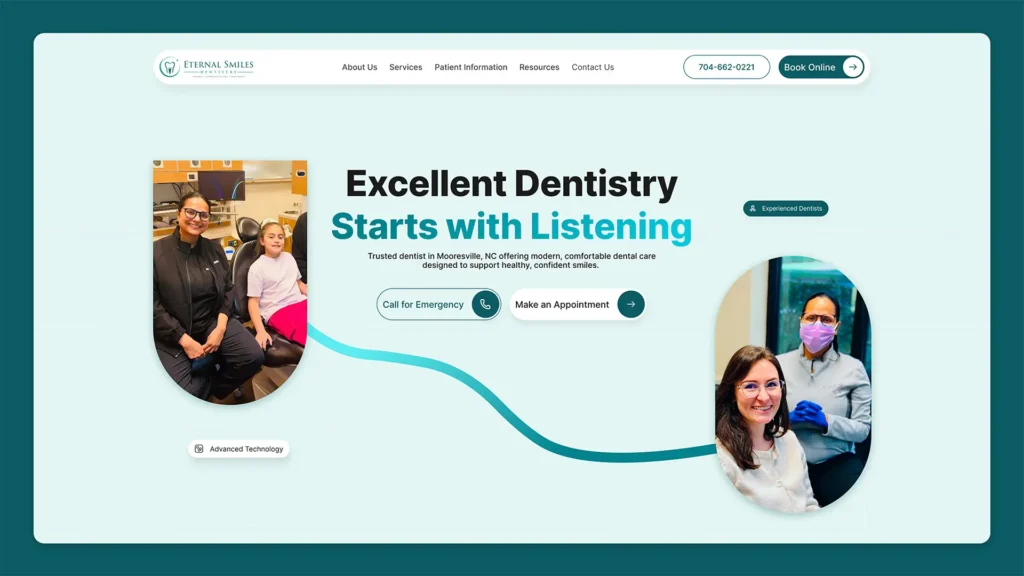
Home From Local Dental Practice to a Patient-First Digital Brand SilverXis brought branding, website, UX, content, SEO, and digital marketing together to build a stronger digital presence for Eternal Smiles. Home Turning Sixty Disconnected Systems Into One Data-Driven Platform SilverXis brought branding, website, UX, content, SEO, and digital marketing together to build a stronger digital presence for Eternal Smiles. Client Overview Eternal Smiles is a dental practice in Mooresville, North Carolina, founded and led by Dr. Megha Agrawal, a dentist with more than 10 years of clinical experience. The practice provides comprehensive dental care, with a strong focus on implants and emergencies. As Eternal Smiles prepared to strengthen its presence in the local market, it needed a digital experience that reflected the quality and approach of its in-office care. SilverXis brought together dental practice branding, dentist website design, content, SEO, UI/UX, Google Business Profile management, and digital marketing to create a consistent brand experience across its digital and offline presence. The Challenge Eternal Smiles needed more than a new website. The practice needed a complete brand and digital presence that reflected its patient-first approach. The existing presence did not fully communicate the practice’s services, philosophy, or the experience patients could expect. There was also an opportunity to make it easier for local patients to discover the practice and understand its range of dental services. The project required a coordinated approach across dental practice branding, dental practice website development, content, SEO, and marketing collateral rather than treating each piece separately. The SilverXis Approach SilverXis brought the brand, digital, and content pieces together under one strategy. Dental Practice Branding: Developed a refreshed visual identity, including logo development, brand messaging, posters, brochures, and supporting marketing materials. Dentist Website Design: Designed and developed a new dental practice website with a clear structure, intuitive navigation, and patient-focused messaging. UI/UX: Created a simple and approachable experience that helps patients find information, explore services, and take the next step more easily. Dental SEO Services: Built and optimised website content around relevant dental services and patient search queries to create a stronger foundation for local visibility. Google Business Profile Management: Managed and optimised the Eternal Smiles Google Business Profile to strengthen its local presence and help prospective patients discover the practice, services, and location. Digital Marketing: Developed a broader dental clinic marketing strategy bringing together the website, SEO, content, Google Business Profile, and ongoing marketing efforts. Building a Better Patient Experience The new Eternal Smiles experience was built around a simple idea: patients should feel heard before they feel treated. That thinking shaped everything from the website structure to the content and visual identity. Information was written in a clear, approachable way, helping patients understand their options without feeling overwhelmed. The new digital presence also gives greater visibility to key areas of care, including dental implants, veneers, clear aligners, and general dentistry. This created a stronger foundation for both dental patient acquisition and ongoing patient relationships. The Results The transformation gave Eternal Smiles a more consistent and patient-focused presence across its digital and offline touchpoints. Local Visibility A stronger digital foundation for reaching patients across Mooresville, Lake Norman, and the greater Charlotte area. Patient Engagement A clearer website experience that helps patients find information and understand their treatment options. Service Discovery Improved visibility for key services, including cosmetic, restorative, implant, and general dentistry. Brand Experience A unified identity across the website, marketing materials, content, and patient-facing communication. Looking Ahead SilverXis continues to support Eternal Smiles through dental SEO services, content, Google Business Profile management, and ongoing dental practice digital marketing. The new foundation gives the practice room to build its local visibility, strengthen patient engagement, and continue growing its digital presence. “We had a great experience working with SilverAxis on our dental office website. The entire team was professional, responsive, and easy to work with throughout the process. I would definitely recommend SilverAxis to other businesses looking for a reliable and responsive website development team.” Founder & Lead Dentist , Eternal Smiles Ready to build a stronger digital presence for your practice? SilverXis builds branding, websites, SEO, AEO, GEO, GBP, and social media programs for service businesses ready to turn expertise into a growing client base. Contact SilverXis at silverxis.com to start your engagement. Book a Strategy Call +1(214) 725-0162
TAP & TABLE

Home Seven New Clients Including an Industry-Leading National Brand Landed in Less Than Six Months SilverXis helped a new Dallas-Fort Worth restaurant consultancy build its digital presence from the ground up. Home Seven New Clients Including an Industry-Leading National Brand Landed in Less Than Six Months SilverXis helped a new Dallas-Fort Worth restaurant consultancy build its digital presence from the ground up. Client Overview Tap & Table is a Dallas-Fort Worth restaurant consulting firm founded in 2025 by Joseph “Rob” Chickering, a restaurant industry veteran with more than 30 years of experience leading operations for multi-location and franchise organizations. Rob started Tap & Table to bring that operator-level expertise to independent restaurants, bars, and hospitality groups across the region, guiding them through concept development, vendor and supply chain strategy, licensing and compliance, menu and mixology programs, turnaround consulting, and launch and event planning. To build his own client base, Rob turned to SilverXis for brand identity, messaging, and full-service digital marketing, including website design, SEO, AEO, GEO, Google Business Profile management, and social media. The Challenge A brand-new consulting firm has no search history, no reviews, and no digital footprint, regardless of how experienced its founder is. Rob’s credibility came from three decades inside restaurant operations, not from a prior public-facing brand. To win clients, Tap & Table needed to translate that operator experience into a brand and online presence that restaurant and bar owners would find, trust, and act on, in a Dallas-Fort Worth market where competition for hospitality clients is dense and largely referral-driven. To build his own client base, Rob turned to SilverXis for brand identity, messaging, and full-service digital marketing, including website design, SEO, AEO, GEO, Google Business Profile management, and social media. The SilverXis Approach SilverXis built Tap & Table’s go-to-market presence from scratch across several coordinated tracks: Brand identity and messaging: Positioning Rob’s operator background into a clear value proposition for restaurant and bar owners considering launch, growth, or turnaround support. Website design and development: A conversion-focused site (TapAndTable.com) built to explain services and audience segments, from startups and independents to multi-unit groups, franchise buyers, and struggling concepts, and to convert visitors into consultation bookings. SEO, AEO, and GEO: On-site and technical optimization aimed at both traditional search visibility and the answer engines and generative AI tools increasingly used in local business discovery. Google Business Profile management: Building and maintaining a fully optimized GBP presence to support local search visibility and credibility signals in the DFW market. Social media: Ongoing content and management to build brand presence and support the digital marketing program. Who Tap & Table Serves Part of the messaging challenge was scope. Tap & Table works with a wide range of operators, and the brand and website needed to speak credibly to all of them: Restaurants: startups, independents, multi-unit groups, specialty cuisine concepts, fine dining, fast casual/QSR, ghost kitchens, franchise buyers, and struggling concepts in need of a turnaround. Bars and Lounges: new bar ventures, experience-driven concepts, breweries and taprooms, bar-restaurant hybrids, nightlife and clubs, and neighborhood refreshes. SilverXis built the site’s information architecture and content around these segments directly, so a franchise buyer, a struggling independent, and a brewery owner would each find language that spoke to their specific situation rather than one generic pitch. The Results Tap & Table’s digital presence began generating business almost immediately. Within three months of launch, the website had produced three new client engagements. Over the following two months, Tap & Table landed three more, including one national brand, bringing the firm to six clients inside its first five months of operation. That early traction has continued. As of today, Tap & Table is on pace to grow its client base by another 50 percent by the end of 2026, building on the foundation of a brand and digital presence built for credibility from day one. Looking Ahead SilverXis continues to support Tap & Table’s SEO, AEO, GEO, GBP, and social media programs as the firm scales past its first six clients toward its 2026 growth target. The engagement remains a working example of how a services firm with no prior brand can use a coordinated digital strategy, rather than word of mouth alone, to build a credible, visible presence in a competitive local market. That early traction has continued. As of today, Tap & Table is on pace to grow its client base by another 50 percent by the end of 2026, building on the foundation of a brand and digital presence built for credibility from day one. “SilverXis did not simply give us a website or run a marketing campaign. They helped turn more than three decades of restaurant experience into a visible, credible brand and a growing consulting business.” Founder , Tap & Table Ready to build a brand and digital presence that matches your expertise? SilverXis builds branding, websites, SEO, AEO, GEO, GBP, and social media programs for service businesses ready to turn expertise into a growing client base. Contact SilverXis at silverxis.com to start your engagement. Book a Strategy Call +1(214) 725-0162
Do You Need an Ecommerce Marketing Agency? Key Signs to Know
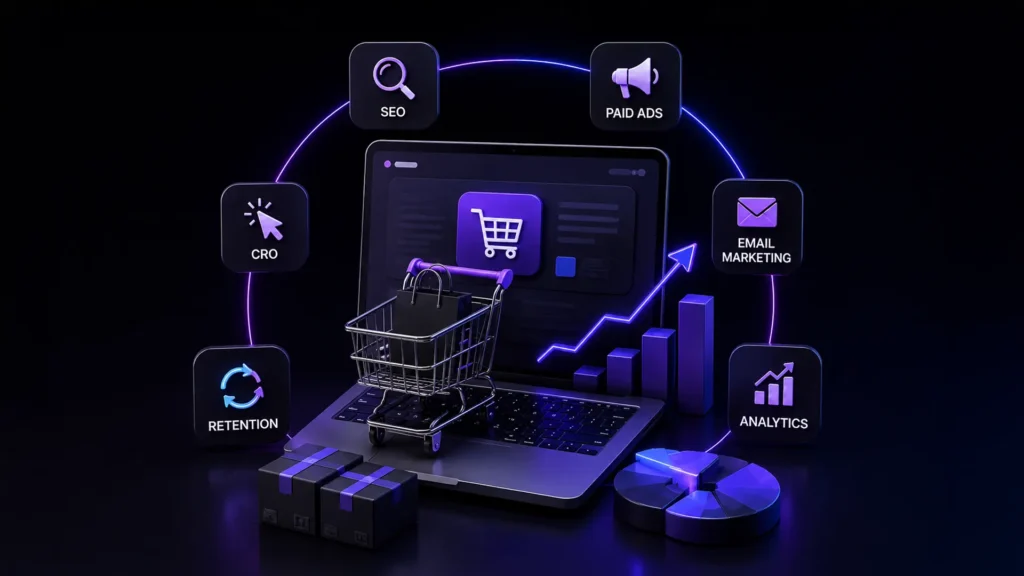
This blog presents what an ecommerce marketing agency does, when you might need one, and how to choose the right partner for your business.
Digital Marketing for Dentists: Cost, ROI & What to Expect

Here’s how most people pick a dentist now: they Google it → skim reviews → check the website, and then decide before dialing a number. That’s why digital marketing for dentists is now central to running a practice. Competition for those searches has only gotten tighter as more practices move their marketing online, which makes coasting on word-of-mouth alone a lot harder than it used to be. This guide walks through what digital marketing for dentist actually involves, what it tends to cost, and how to tell if it’s working. So that you can build something that fits your practice instead of copying a generic playbook. What Digital Marketing for Dentists Includes Today A website and a Facebook page used to be enough but not anymore. Digital marketing for dentist offices now covers search visibility, paid ads, reviews, and content. The systems need to turn a site visitor into an actual patient. Essential Services Every Dentist Should Prioritize Most practices need a handful of things working together: Local SEO A website that is mobile-friendly. It needs to have online booking built in as well. An active, well-managed Google Business Profile Review generation, since most people check ratings before calling Paid search or social ads to fill gaps organic traffic doesn’t cover Email and SMS recall campaigns to bring existing patients back Keeping a current patient is almost always cheaper than winning a new one, and that is where email and sms become important. Building a Digital Marketing Strategy for Dentists A real digital marketing strategy for dentists starts with a goal, not a tactic list. Filling hygiene chairs, growing a service like Invisalign, or opening a second location each point toward a different mix of channels, budget, and timeline. Copying a competitor rarely works as well as building around your own numbers. This is where a specialized partner like Silverxis adds value, turning those goals into an actual channel plan. Choosing Between In-House Marketing and an Agency Bigger practices with dedicated staff can handle this in-house. Still, most single-location dentists get steadier results by working with a digital marketing agency for dentists. They are a team that already has systems built out. It comes down to control versus speed. Agencies move faster since they’re not starting from zero, and a team with dental experience already knows which channels tend to pay off first. How Much Does Digital Marketing for Dentists Cost? There’s no fixed price here. The cost of digital marketing for dentists depends on practice size, local competition, and growth pace. Typical Budget Ranges by Practice Size For scale, the average general dentist brought in $965,660 in gross billings in 2025, according to the ADA Health Policy Institute. It is a useful benchmark for sizing up what a reasonable marketing investment looks like relative to overall revenue. A single-location general practice usually falls somewhere in the low-to-mid thousands per month. A multi-location practice running paid campaigns across sites will land considerably higher. Factors That Influence Marketing Costs A few factors play a crucial role in determining how much you will spend on marketing your practice: How saturated your local market is, dense metro areas cost more per click. Whether you’re targeting competitive specialties like implants or orthodontics How much design and content work your website needs Whether you’re hiring in-house or working with a digital marketing agency for dentist that bundles services SEO and reputation work take time to compound, so budget for six to twelve months before expecting the full payoff. Agencies that specialize in dental clients, like Silverxis, already know roughly what a realistic budget and timeline look like, rather than starting the estimate from scratch. Measuring ROI from Digital Marketing for Dentist Offices Traffic and click counts look nice in a slide deck, but they don’t pay rent. Real ROI from digital marketing for dentist offices boils down to one thing. How many new patients booked, showed up, and stuck around. The Metrics That Matter Beyond Website Traffic Worth tracking instead of vanity numbers: Cost per new patient Case acceptance rate Patient lifetime value It’s also worth watching practice capacity. Plenty of practices have open chair time sitting alongside steady patient demand. That gap is usually a visibility problem rather than a market problem which is exactly what a good ROI review should catch. How SEO, PPC, and Local SEO Drive New Patients Local SEO and a strong Google Business Profile bring in the steadiest flow of new patients, since most people search “dentist near me” rather than a specific name. PPC works faster for pushing a service like Invisalign, but results stop the second you stop paying. Running both together, PPC for quick wins and SEO for the long-term pipeline, usually works best, which is the combination behind most digital marketing agencies for dentist retainers. Choosing the Right Digital Marketing Agency for Dentists Not every digital marketing agency for dentists is built the same way. You’ll notice the difference a few months in. Look for one with verifiable dental clients; general healthcare experience doesn’t always translate, since dental patient behavior and local competition work differently. Ask how they report results. The best digital marketing for dentists comes from agencies tying reports back to new patients and revenue, not just rankings. Check contract terms too; a confident agency won’t need a long lock-in. If you run a specialized practice, look for matching specialization. The best digital marketing for pediatric dentists comes from agencies fluent in parent-focused messaging. Best Digital Marketing Strategies for Different Dental Practices The right strategy shifts depending on what kind of practice you’re running, and treating every dentist like the same buyer usually leads to wasted spend. General practices – strong local SEO, an optimized Google Business Profile, and steady review generation, since most patients are searching by location and trust signals. Cosmetic and specialty practices – PPC and social ads built around before-and-after visuals, paired with landing pages for one specific service. Pediatric practices – the best digital marketing for pediatric
GBP SEO Tips to Get More Local Calls and Customers
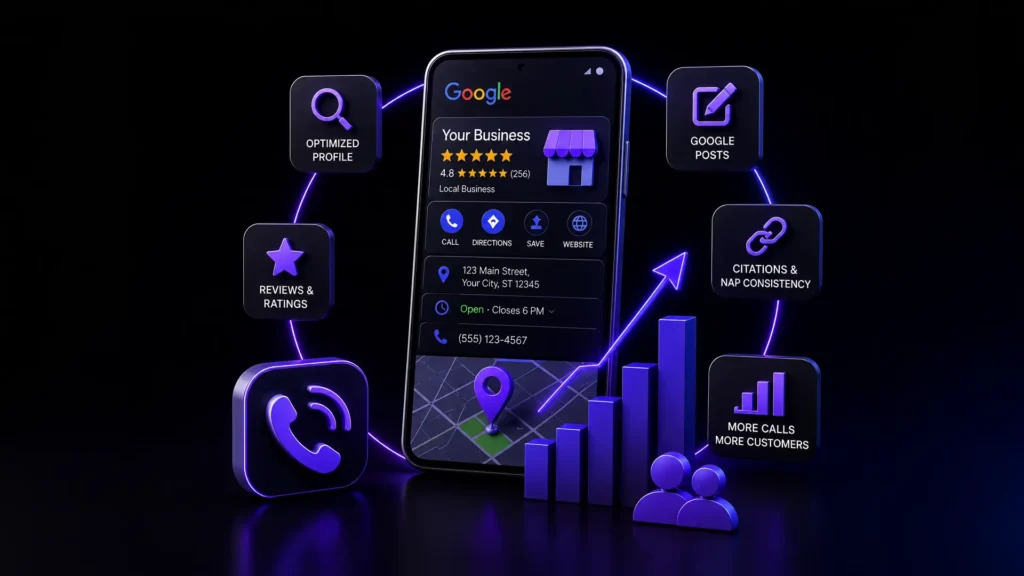
This paper turns that behavior into a clear GBP SEO plan any business can follow. The stakes are real: the average business profile gets about 1,009 searches per month, 16% of businesses see 100+ calls monthly directly from Google, and 87% of consumers read reviews before choosing a local business (BrightLocal).
Do You Need an Ecommerce Marketing Agency? Key Signs to Know

Growth in an ecommerce business does not rely only on how well your store functions. You need to market your name. Only through marketing can your business stand out from the competitors. The customer should know that your brand can adapt to their evolving expectations. It becomes the way to make sure your growth does not stagnate. You need the customer to keep coming back, as well as for new customers to find you. For that, you need the right audience. That is where an ecommerce marketing agency comes in. It becomes a practical business decision when sales decline, and campaigns take longer to launch. This blog presents what an ecommerce marketing agency does, when you might need one, and how to choose the right partner for your business. Do You Need an Ecommerce Marketing Agency? Key Signs to Watch The need for an agency is dependent on the scale of your business growth. If a limited range of products or a focus on the local customer base describes your business, an internal marketing team can handle it. But if you want to have a larger growth, marketing becomes important. You need expertise in the following areas, to name a few: Search engine optimization (SEO) Paid advertising Email automation Conversion Rate Optimization (CRO) Analytics Customer Retention Without the right skills or resources, managing these channels will often lead to inconsistent results. If you see that the spending on marketing has little improvement in sales, consider whether outside support can help. Signs It’s Time to Hire an Ecommerce Marketing Agency Not every business needs outside marketing support but certain problems can be clear signs that your approach needs to change. Your Traffic Is Growing, but Sales Are Not Website traffic matters more when translating into revenue. The reasons for the low conversion rate of visitors into customers can be: Poor landing page A slow site Ineffective product page Complicated checkout An ecommerce website agency looks at the causes through analytics. User behavior insights guide the next steps. They employ A/B testing to identify where potential customers are dropping off and recommend improvements. The customer journey is what impacts conversion rate. Your Team Lacks Time or Specialist Marketing Skills Marketing does not have only one aspect. As mentioned above, it requires expertise in different skills. Running an SEO campaign and managing paid advertising is different. One internal team cannot manage all channels. That is unrealistic. An agency provides access to specialists, such as an ecommerce marketing consultant, without the additional time and cost needed to hire full-time employees. With a marketing agency, your internal team can focus on the products, operations, and customer service. You’re Expanding to New Markets or Sales Channels The need for the marketing agency is correlated to whether you want to bring your business to a larger, newer audience. New channels and locations introduce new challenges. International ecommerce for example, is not the same as national ecommerce. The different markets can require: SEO content that is localized. A region-specific advertising strategy. Payment options are valid there. Messaging tailored for the new audience. An experienced e-commerce agency can help coordinate these activities. It will also reduce the learning curve as your business grows. How to Choose the Best Ecommerce Marketing Agency When choosing an ecommerce digital marketing agency, look for one that understands your business rather than simply choosing the largest provider. There are certain parameters that need to be considered when looking at potential partners: Do they have experience working with ecommerce brands? Do they understand your platform and technology stack? Do they measure success using business outcomes rather than vanity metrics? Do they communicate regularly with transparent reporting? Do their services scale as your business grows? Finding the best ecommerce marketing agency for you has to be made based on examples of their previous work, their reporting methods, and how they measure success. Comparing In-House Marketing vs an Ecommerce Digital Agency The benefits of an in-house team are that they know the product well and allow close collaboration. But building expertise is costly. It has to be developed across SEO, paid media, analytics, and content. Multiple specialists become a requirement then. An ecommerce digital agency gives immediate access to such varied specialists. Not just that, but also they deal in proven processes and marketing technologies. It allows them to scale resources as the campaign requirements change. For a growing ecommerce business, a hybrid approach is more effective. The internal team provides brand knowledge and strategic direction. The agency can contribute specialist skills and oversee execution. Ecommerce Marketing Services That Drive Measurable Results Different marketing channels serve different purposes. The marketing channels work best when they are planned around the same business goals. The right ecommerce marketing services should work together rather than operate as separate campaigns. SEO, Paid Ads, Email Marketing, and CRO Ecommerce marketing is successful when the channels support each other. They have different roles: SEO focuses on attracting customers actively searching for the products. Paid advertising generates demand and reaches new audiences quickly. Email marketing reaches out to customers, encouraging them to repeat purchases. CRO focuses on the shopping experience so that more visitors complete a purchase. These services create a stronger marketing ecosystem when they work together. Only then can they support sustainable growth. Retention, Personalization, and Customer Lifetime Value Business growth is dependent on both new customers and encouraging repeat customers. That increases customer lifetime value. McKinsey highlights how consumers expect personalized digital experiences. Organizations are using AI to deliver relevant interactions at scale. Customer expectations are not stagnant. 70% of executives say that customers’ expectations are changing faster than the organizations can adapt to, according to a survey by PwC. Poor customer experience is a major reason they stop buying from a brand. What this means for an ecommerce business is that investing in customer retention is important. Some ways of doing this are: Personalized recommendations Loyalty initiatives Segmented email campaigns Continuous experience optimization Solely acquiring new customers is not
Full Site Content Refresh vs Website Redesign: Which Delivers Better ROI?
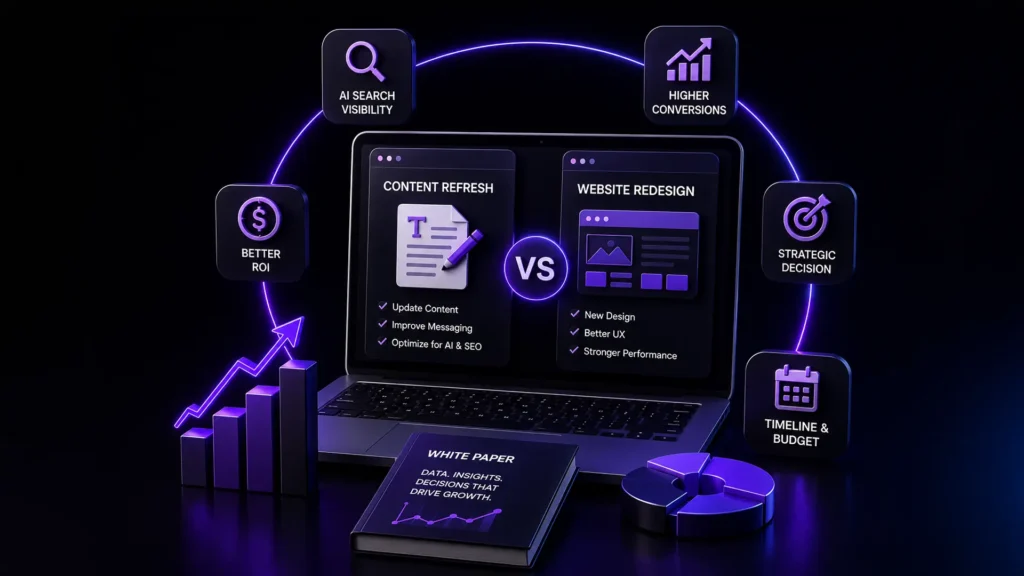
This white paper looks at how the stakes have shifted. AI is now shaping how buyers research and evaluate vendors. Market data also shows the real cost pressure across the web design industry. So businesses need a clear framework for deciding where to invest.
ChatGPT Paid Ads Are Coming. Should You Pay Attention?

ChatGPT ads may soon become part of more marketing plans, but that does not mean every business should start spending right away. This blog looks at what needs to be in place first, from the offer and landing page to tracking and lead quality. It also explains where ChatGPT ads may fit beside regular search campaigns.
Top Agency Growth Factors for a Fast, Scalable Business Model

Building an agency is difficult. Even harder is building one that keeps growing without falling apart from the strain of running it. A popular misconception within agencies is that revenue growth means scalability until supply chains are cracking at the seams under a success load. You start to pull in clients, the revenue ticks up, and everything looks green on the outside. On the inside, delivery begins to slow, communication becomes reactive, margins begin to compress, and founders find themselves stuck in the day-to-day execution. This is where the difference between growth and a truly scalable business model becomes clear. Agencies in 2026 face higher client expectations, tighter timelines, and increasing pressure to deliver measurable results. At the same time, AI tools are commoditizing basic execution services across industries. Agencies that continue scaling successfully are the ones building operational clarity, repeatable systems, and sustainable growth structures. At SilverXis, one pattern appears consistently across growing agencies: most operational problems emerge because systems fail to mature at the same pace as revenue growth. That gap determines whether scaling a business becomes sustainable or chaotic. What Does Scaling a Business Mean? Many agency owners still ask, “What does scaling a business mean beyond getting more clients?” – The answer is operational leverage. For agencies, scaling a business means increasing revenue without increasing operational complexity at the same rate. A scalable business model allows agencies to absorb growth without damaging profitability, delivery quality, or client experience. For example:Hiring five employees just to manage five new clients may help a business grow, but it also increases costs and operational pressure. True scalability happens when a company can handle those same five clients efficiently through better systems, clear workflows, and smarter processes without constantly expanding the team. This distinction defines true business model scalability. Agencies depend heavily on communication, service delivery, and operational coordination. Without systems, growth creates friction instead of efficiency. A scalable agency typically relies on: Standardized workflows Service standardization Workflow automation Capacity planning Repeatable onboarding Retention-focused client management Clear positioning One overlooked issue in scaling a business is that operational complexity compounds quietly. An agency managing 10 retainers manually may function adequately. At 40 retainers, undocumented processes often create severe delivery bottlenecks. Why Most Agencies Struggle With Scaling Most agencies are built for client servicing, not long-term scalability. In the early stages, founders usually manage sales, delivery oversight, hiring, operations, and client communication themselves. This creates speed initially, but founder dependency quickly becomes one of the biggest challenges of scaling a business. At SilverXis, we have seen that brands facing scaling challenges usually deal with the same operational issues: Every project follows a different workflow Reporting structures vary between accounts Onboarding lacks consistency Communication becomes reactive Delivery timelines become unpredictable Many agencies believe hiring alone solves scalability issues. In reality, premature hiring often amplifies inefficiencies already present inside the business. When systems are unclear: Delegation becomes inconsistent Accountability weakens Margins shrink Delivery quality fluctuates This is why many agencies eventually hit a revenue ceiling where additional growth creates more operational stress than profitability. Growth Factors Behind a Scalable Business Model A scalable business model is built on systems that support growth without creating operational overload. Businesses that scale successfully usually focus on improving efficiency, creating repeatable processes, and reducing dependency on manual work. Productized Services Improve Efficiency One of the strongest drivers of business model scalability is service standardization. Highly customized services create operational chaos because every project requires different workflows, communication patterns, and timelines. Scalable agencies reduce complexity through productized services. For example, offering a general “SEO Retainer” can create confusion around deliverables, timelines, and expectations. On the other hand, a clearly defined “90-Day Local SEO Growth Sprint” gives both the agency and the client a structured process with measurable outcomes. This improves onboarding consistency, workflow automation, margin predictability, and operational efficiency. Productized services also make delegation easier because teams work inside repeatable systems instead of rebuilding workflows for every client. The more repeatable your systems become, the easier scaling a business becomes operationally. Systems Determine Scalability Many agencies believe talent is the main growth driver. In reality, systems sustain long-term scalability. Critical operational systems include: SOP documentation Project management workflows Reporting infrastructure Client lifecycle management Quality assurance systems Internal accountability frameworks Strong systems create: Delivery consistency Faster onboarding Better delegation Lower operational stress Healthier margins One practical benchmark for evaluating how scalable your business model is simple: if the founder cannot step away from daily operations for two weeks without disruption, the business likely is not operationally scalable yet. Smart Outsourcing Supports Growth The discussion around outsourcing agency scalability factors business growth continues to expand because agencies increasingly rely on flexible operational structures. However, outsourcing only improves scalability when internal systems already exist. Outsourcing works best for: Repetitive execution tasks Overflow production support Technical specialization Process-driven deliverables The most scalable agencies usually operate through hybrid structures that combine internal strategic leadership with external execution support. Positioning Impacts Scalability Weak positioning creates operational complexity. Agencies attempting to serve every industry and client type often struggle with inconsistent delivery because expectations constantly shift. Specialized agencies scale faster because: Messaging becomes clearer Lead quality improves Delivery systems become repeatable Client expectations align better Pricing power increases For example, calling yourself a “marketing agency” can lead to unclear expectations because the services can vary widely from one client to another. But positioning your business as a “performance marketing agency for SaaS startups” creates a clearer focus, making delivery and client expectations easier to manage. Specialization often improves scalability faster than simply expanding service offerings. Retention Drives Sustainable Growth Most agency growth conversations focus on getting new clients, but retention is often what truly supports long-term scalability. Agencies with poor retention usually end up stuck in a cycle of constantly replacing lost clients, which makes growth unstable and difficult to predict. On the other hand, agencies that retain clients longer benefit from more predictable revenue, stronger profitability, and better resource planning. Client retention also improves
How to Choose the Right Digital Marketing Tools for Your Business Goals
While selecting the appropriate technology stack has become a “nice-to-have” for businesses, it is now the driver for growth. As we continue to navigate our way through 2026, the world’s digital advertising and marketing market is estimated to reach a staggering figure of $786.2 billion (WordStream, 2026). With such high stakes, the difference between a thriving campaign and a wasted budget often comes down to the digital marketing tools you choose to support your goals. However, with thousands of platforms available, the “paradox of choice” is real. Whether you are a solo entrepreneur or looking for the best tools for digital marketing agency workflows. 1. Aligning Tools with Your Core Business Goals Before searching for the top digital marketing tool, you must define what success looks like. Tools are meant to solve problems, not create them. Goal: Brand Awareness – Focus on tools for digital marketing that prioritize reach and engagement, such as social media management suites (Hootsuite, Sprout Social). Goal: Lead Generation – You need robust digital marketing agency tools that offer CRM integration and automated funnel tracking (HubSpot, Salesforce). Goal: Organic Growth – High-authority seo tools for digital marketing are non-negotiable here (Semrush, Ahrefs). 2. The Power of Data: Market Research & Reporting You cannot manage what you cannot measure. In 2026, data is the “new oil,” but only if you have the right refinery. Digital Market Research Tools Understanding the audience is the first step. Digital market research tools like AnswerThePublic or Google Trends help you identify what your customers are searching for in real-time. According to recent stats, 81% of shoppers research online before making a purchase (GE Capital Retail Bank). If you aren’t using research tools to meet them at that research phase, you’re losing 80% of your potential market. Digital Marketing Reporting Tools For agencies, transparency is the currency of trust. Utilizing digital marketing reporting tools like Looker Studio or NinjaCat allows you to consolidate data from various channels into one dashboard. 3. The SEO & Content Pillar Organic search remains the most sustainable traffic source. In fact, 53% of all website traffic comes from organic search. To capture this, your toolkit must include professional seo tools for digital marketing. Keyword Research: Identifying high-intent, low-competition terms. Technical Audits: Using the ebest tools for digital marketing to find broken links or slow-loading pages that hurt your rankings. Competitor Analysis: Seeing exactly which keywords your competitors are bidding on or ranking for. 4. The Rise of Efficiency: Best AI Tools for Digital Marketing 2026 is the year of the “AI-Augmented Marketer.” We are no longer just using AI for chat; we are using it for predictive analytics and hyper-personalization. The best AI tools for digital marketing today include: Jasper & Copy.ai: For scaling high-quality content while maintaining brand voice. Surfer SEO: Combining AI with search data to optimize content for 1st-page rankings. Albert.ai: An AI “pilot” that automates ad buying and optimization across social and search. 5. How to Evaluate a New Tool (The Checklist) When considering a new addition to your stack, ask these four questions to ensure it meets EEAT standards: Integration: Does it “talk” to your existing CRM and email platforms? Scalability: Will this tool work even when your lead volume triples? Data Security: Is it GDPR/CCPA compliant? (Vital for building customer trust). Learning Curve: Does the vendor provide enough support and documentation? Tool Category Primary Function Top Recommendation for 2026 SEO Rankings & Traffic Semrush Reporting Data Visualization Looker Studio AI Content Scaling Production Jasper AI All-in-One CRM & Automation HubSpot 6. Industry Statistics You Can’t Ignore ROI of Email: Email marketing continues to offer an average ROI of $36 for every $1 spent. Video Dominance: 91% of businesses use video as a marketing tool, making video-focused tools like Descript or Sora essential. Budget Shifts: 72% of overall marketing budgets are now allocated to digital channels. Strategy Over Software The best tools for digital marketing are useless without a clear strategy. A tool is a lever; your strategy is the fulcrum. First, pick one “pain point”, maybe your reporting takes too long, or your SEO efforts have stagnated, with the specific tool in mind to address it. Elevate Your Strategy with SilverXis Navigating the complex world of digital tools can be overwhelming. At SilverXis, we don’t just provide services; we build high-performance digital ecosystems. You may need a trusted digital marketing agency to manage all your tools or develop a personal strategy yielding tangible ROI. We are here to help you scale. Ready to transform your digital presence? Contact SilverXis today for a free Audit! FAQs Is custom software better than off-the-shelf? If your needs are unique or you want a competitive edge, yes. Custom software adapts to you, whereas you must adjust to off-the-shelf tools. How long does the development process take? A typical project can range from 3 to 9 months, depending on complexity. We focus on delivering value in phases so you can start seeing impact early. Will I own the source code? With SilverXis, absolutely. You retain 100% ownership of the Intellectual Property (IP). If your needs are unique or you want a competitive edge, yes. Custom software adapts to you, whereas you must adjust to off-the-shelf tools. A typical project can range from 3 to 9 months, depending on complexity. We focus on delivering value in phases so you can start seeing impact early. With SilverXis, absolutely. You retain 100% ownership of the Intellectual Property (IP).